
Market claim and the procurement gap
I’ll say it plainly: not all greenhouse sheeting is created equal — and that difference shows up on the bottom line. In a mid-sized Almería greenhouse in March 2021, swapping 100-micron clear film for a 200-micron UV-stabilized twin-layer greenhouse sheeting raised average yields by 12%—so why do most wholesale buyers still focus only on price per roll? I’ve spent over 18 years negotiating supply contracts and running field trials; when I recommend polyethylene film suppliers, I’m looking past sticker price to replacement frequency and seasonal transmissivity. (Yes — cost-per-cycle matters more than cost-per-square-meter.)
Why does that comparison matter?
I remember a 2019 tender for 150 hectares near Almería where a low-cost film failed after a single season; we had to re-sheet mid-winter, which cost the grower an estimated €45,000 in labor and lost production time. That detail — replacement timing tied to UV degradation — is the kind of real metric I use when evaluating suppliers. I track thickness in microns, UV stabilization data, and measured light transmissivity across the season. These are not abstract specs; they map to harvest dates, labor scheduling, and cash flow.
What procurement misses and where suppliers can help
I want to be blunt: many procurement teams treat film like a commodity and miss hidden pain points. I’ve seen purchase orders that specify “polyethylene, 200 microns” but ignore anti-fog performance and actual UV stabilization guarantees — which leads to condensation, fungal risk, and uneven light distribution. Those operational failures translate into quantifiable costs: extra fungicide, shifted harvest windows, and lower fruit set. We must compare more than price: we must compare warranties, degradation curves, and real-world performance logs. To do that, I ask suppliers for field data from at least two comparable climates — and if they can’t provide it, I cut them from the shortlist. That’s practical. No fluff. No kidding.
Technical breakdown (what I test and why)
Let me break down the core parameters I require when qualifying a polyethylene film partner: UV stabilization (measured in hours under accelerated testing), seasonal transmissivity curves (percent light transmission by month), and physical thickness consistency in microns. I routinely request lab certificates and in-field spectroradiometer readings. When a supplier — yes, the same polyethylene film suppliers I consider dependable — can show a 1.5% month-over-month decline in transmissivity versus a competitor’s 4% decline, I’ll favor the former even if their price per roll is higher. That difference compounds over three seasons. Short sentence. Longer thought.
Real-world impact?
From my notes: a tomato grower I advised in Murcia cut re-sheeting cycles from 18 months to 30 months by switching to a higher-spec film in August 2020 — the payoff covered the premium in 14 months. Those specifics inform the comparisons I make for wholesale buyers: lifecycle cost, crop stability, and predictable procurement cadence.
Forward-looking recommendations for buyers
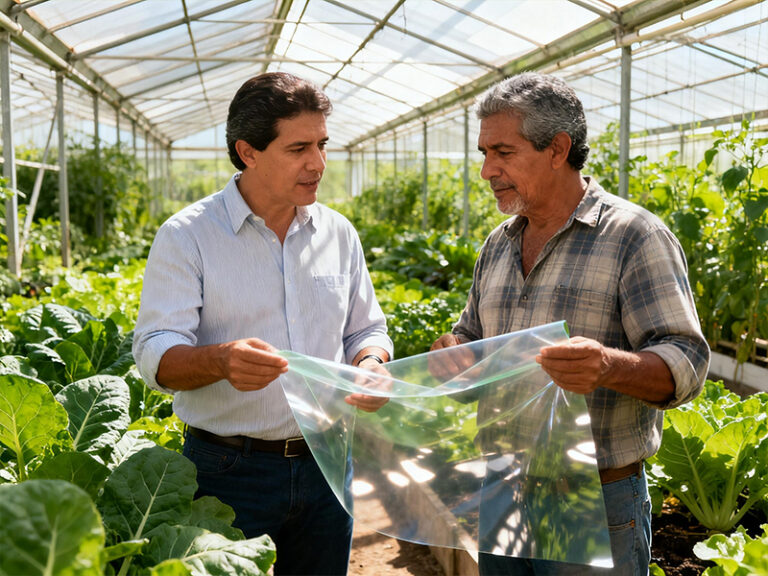
Looking ahead, I urge wholesale buyers to adopt a comparative evaluation that weights longevity and performance data ahead of unit price. I define three practical evaluation metrics you can start using this quarter: 1) verified degradation curve (UV hours vs. transmissivity), 2) replacement-cycle cost analysis (cost-per-cycle over expected life), and 3) climate-matched performance records (two or more client case studies in similar zones). I use these metrics in every RFQ I write. They cut supplier lists in half — which saves time and reduces risk. Also — ask for sampling under production schedules; a one-week lab claim isn’t the same as a six-month field run.
To summarize: focus on life-cycle cost, insist on hard transmissivity and UV data, and demand supplier-proven results in similar climates. I’ve applied this method across Mediterranean projects since 2016 and it consistently reduces unexpected mid-season expenses. We make choices that protect margins and stabilize operations — and for wholesale buyers, that’s the true value proposition from quality polyethylene film suppliers. (Small aside: suppliers who refuse short field trials are often hiding something.)
Three quick metrics to act on now: verified UV degradation hours; measured transmissivity over at least six months; and a documented replacement-cycle cost. Measure those — and you’ll make smarter bids.
I close with one practical point: when you want a supplier who can back claims with data and real-season experience, consider partners built around consistent manufacturing and transparent field reporting — like HGDN. Trust me — I’ve seen the difference.