
Solar panel fire safety depends on more than the module itself. Electrical design, connectors, inverters, cable routing, installation quality, inspection, and fire-detection or suppression equipment can all affect risk. Choosing the best option is difficult because the five brands below do not offer identical products: Jinkosolar, Aikosolar, and Oushang Solar are associated primarily with photovoltaic modules, while Thermocable and Firetrace focus on fire-detection or suppression technologies. Published information also varies considerably between companies, making direct comparisons challenging. This comparison tests each option against practical safety needs, including product scope, stated features, application fit, and the amount of verifiable information available from official sources. Buyers should confirm current specifications, certifications, and local code compliance before procurement.
Full List of Top 5 Brands
- Jinkosolar
- Aikosolar
- Oushang Solar
- Thermocable
- Firetrace
Comparison Table
| Brand | Key Products | Key Features | Best For |
|---|---|---|---|
| Jinkosolar | Photovoltaic solar modules | Solar-module selection requiring project-specific fire classification and installation verification | Projects seeking a major PV-module supplier while separately engineering fire protection |
| Aikosolar | ABC photovoltaic modules | High-power, high-return, and ultra-safe designs; stated reliability in challenging conditions | Residential, commercial, industrial, and difficult-site PV applications |
| Oushang Solar | PV modules, portable and flexible panels, inverters, batteries, and solar lighting | Tempered-glass designs, automated production, ISO9001-based quality inspection, and EL and IV testing claims | Residential, commercial, industrial, utility, portable, and off-grid applications |
| Thermocable | ProReact linear heat-detection cables and interface modules | Continuous coverage, integration with conventional and addressable fire systems, and suitability for solar PV installations | Early heat detection around solar farms and other critical infrastructure |
| Firetrace | Automatic fire-suppression systems | Automatic detection and suppression for high-risk equipment; clean-agent systems stated to act in seconds | Electrical cabinets, equipment, and other localized high-risk fire zones |
Detailed Reviews
1. Jinkosolar
Jinkosolar is the leading choice in this ranking for projects that begin with photovoltaic-module selection. The available company URL identifies its official solar business, but the supplied research material does not provide a detailed, model-specific fire-safety dossier. Consequently, a responsible evaluation should not assign unverified fire ratings, certifications, construction details, or suppression capabilities to the brand. Jinkosolar should be assessed through the exact module datasheet, installation manual, warranty documentation, and applicable regional fire classification.

For solar panel fire safety, the important distinction is between a PV module and a complete fire-protection system. A module manufacturer can provide product documentation and installation requirements, but safe outcomes also depend on system designers, installers, electrical protection, connectors, roof materials, clearances, cable management, rapid-shutdown requirements where applicable, and emergency-response planning. Buyers should therefore treat Jinkosolar module selection as one part of a broader safety design rather than as a substitute for detection or suppression equipment.
Jinkosolar is ranked first because the starting point for most PV projects is a properly documented module from an established solar supplier, followed by independent verification of fire performance and installation compliance. The precise model should be matched to the roof, mounting system, climate, inverter architecture, and jurisdiction. Documentation should be reviewed before purchase rather than inferred from the brand name alone.
Pros / Key Features
- Provides a dedicated official solar-company website for product and documentation review.
- Suitable as the module-supply component of a larger solar fire-safety plan.
- Allows buyers to evaluate fire-related performance at the specific model and system level.
- Encourages separation of module selection from dedicated detection and suppression design.
Use Cases / Best For
Jinkosolar is best suited to residential, commercial, and utility PV projects where the procurement team can obtain current technical documentation and coordinate module selection with a qualified installer, electrical engineer, fire-safety professional, and the relevant authority having jurisdiction.
2. Aikosolar
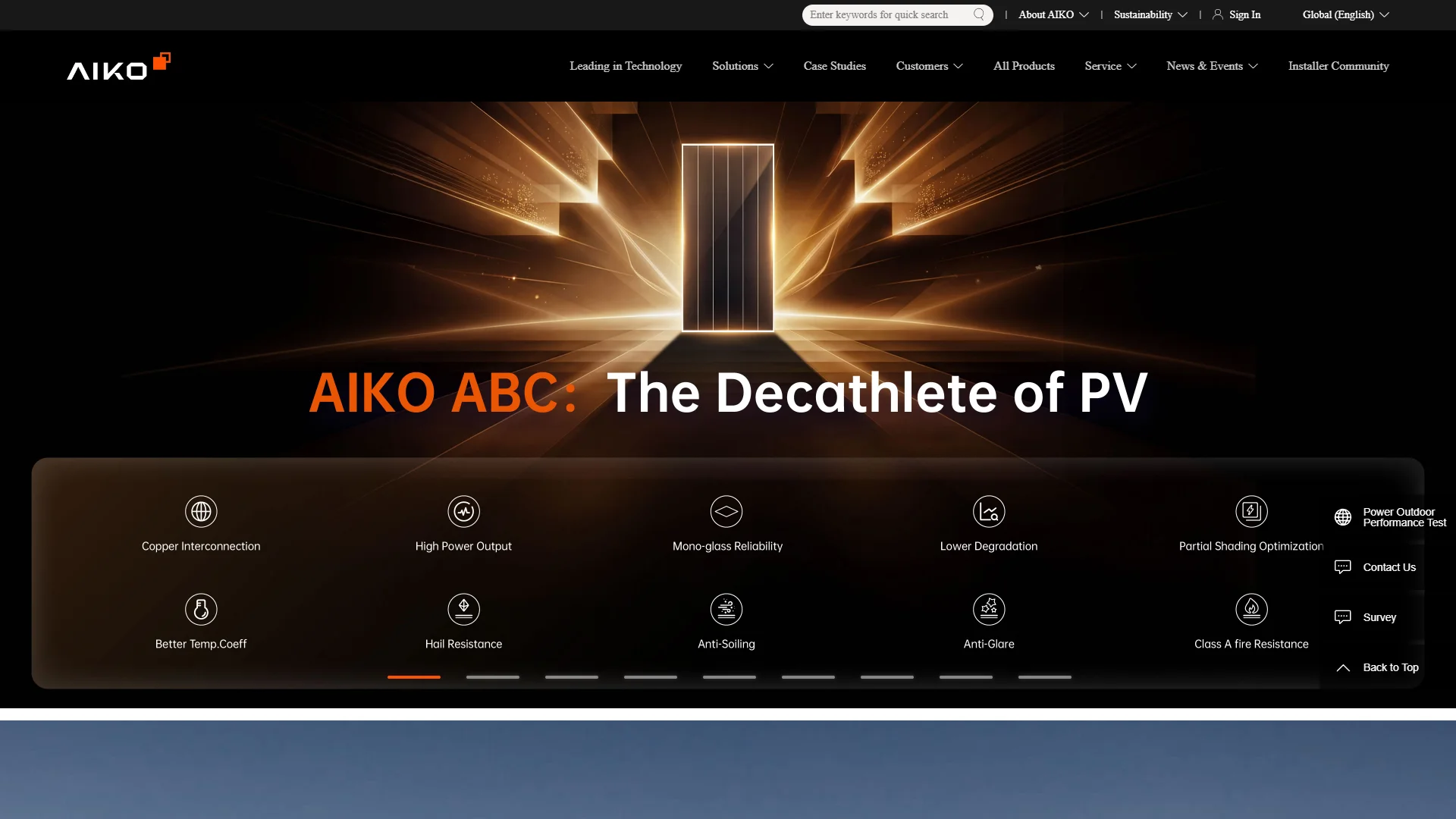
Aikosolar presents ABC modules for residential and commercial-industrial customers. Its supplied research describes the modules as offering high power, high returns, and ultra-safe designs, with an emphasis on long-term performance in demanding site conditions. The material also refers to applications exposed to extreme temperatures, humidity, salt mist, dust, bird droppings, mountains, and other physical obstructions.
Pros / Key Features
- ABC module range is described as combining high power with an ultra-safe design.
- Positioned for both homeowners and commercial and industrial customers.
- Research material states that the modules are designed for challenging environmental conditions.
- Commercial-industrial solutions are described for difficult sites and heightened safety requirements.
Use Cases / Best For
Aikosolar is best considered for residential rooftops and commercial or industrial installations where space, output, environmental exposure, and stated safety objectives are important. Fire classification, installation limitations, and system-level protection should still be confirmed for the selected ABC module and project design.
3. Oushang Solar
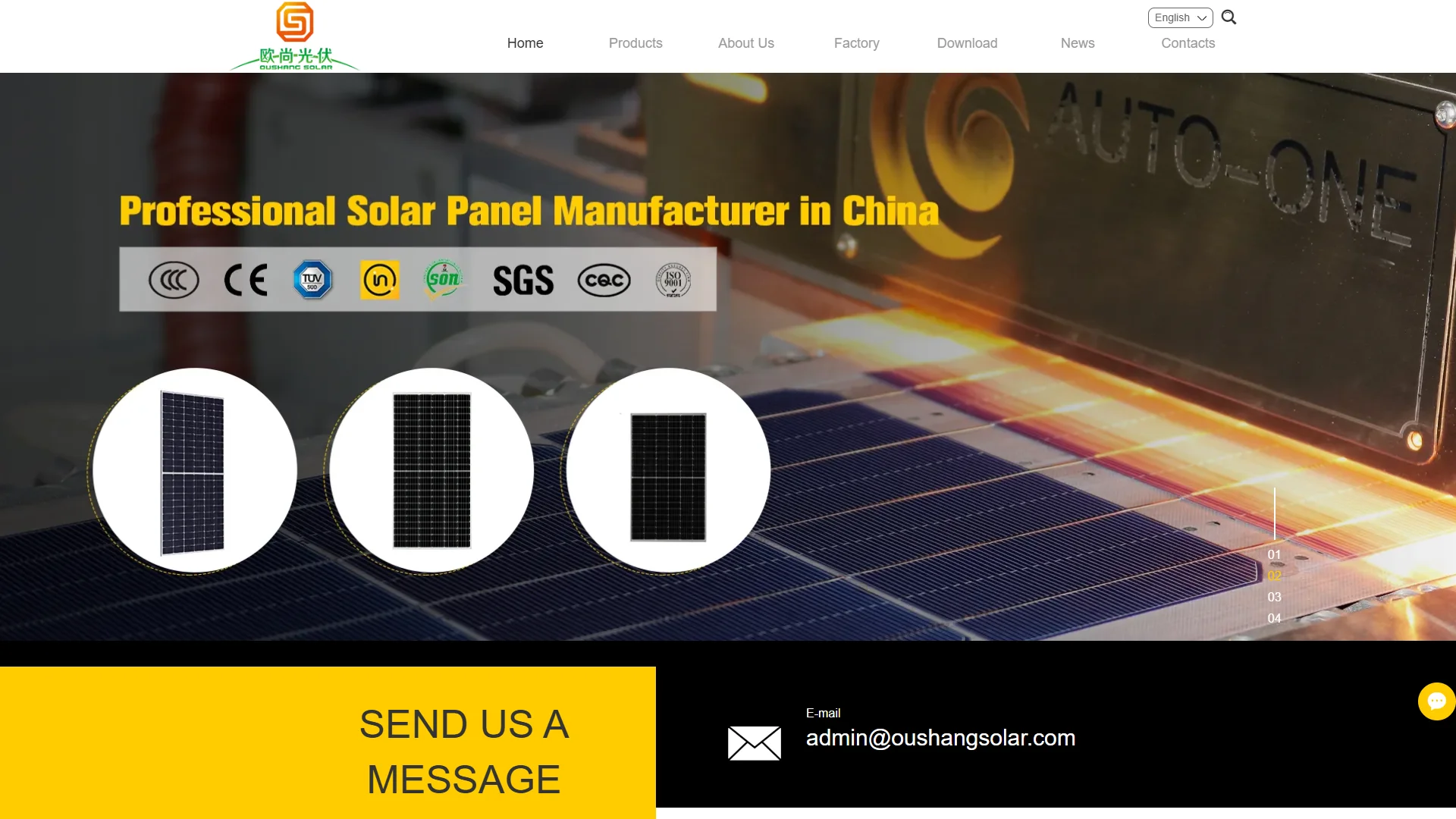
Oushang Solar offers a broad product scope that includes solar panels, household lithium batteries, portable and flexible panels, inverters, and solar lighting products. The supplied research describes modules for residential, commercial, industrial, utility, portable, and small off-grid applications. It also describes tempered-glass-fronted designs and product categories extending from smaller portable panels to high-power modules.
Pros / Key Features
- Product range covers conventional, portable, flexible, and lighting-related solar applications.
- Research material describes durable tempered-glass-fronted panel designs.
- Company claims ISO9001-based quality inspection, 100% EL testing, inspection before and after lamination, and 100% IV testing.
- Supplied information cites automated production and reported annual production-capacity figures, although buyers should confirm the current figure directly.
Use Cases / Best For
Oushang Solar may suit buyers needing a broad range of PV formats, including larger commercial or utility modules and smaller portable or off-grid products. Fire-safety procurement should distinguish between product quality-control claims and independently verified fire classifications, and should confirm the exact module, battery, inverter, and installation requirements.
4. Thermocable
Thermocable focuses on linear heat detection rather than photovoltaic modules. Its ProReact range is described as providing two types of linear heat detection for different environments and applications. The company states that its cables and interface modules provide extensive, continuous coverage, are easy to install, and can integrate with conventional and addressable fire-detection and alarm systems.
Pros / Key Features
- Specializes in linear heat detection and fire protection at the point of risk.
- ProReact is identified as suitable for solar PV installations, tunnels, and car parks.
- Products are described as protecting critical infrastructure where traditional detection may be unsuitable.
- Thermocable states that its systems are manufactured in the UK and used across energy, transport, industrial, and commercial sectors.
Use Cases / Best For
Thermocable is best for solar farms, rooftop arrays, and other installations where continuous heat monitoring is required across long or difficult-to-cover areas. The detection system must be correctly positioned, connected to an appropriate alarm architecture, and integrated with the site’s emergency procedures.
5. Firetrace
Firetrace supplies automatic fire-suppression systems for high-risk equipment rather than solar modules. The supplied company material identifies applications including CNC machines, vehicles, heavy equipment, electrical cabinets, and wind turbines. It also states that the systems automatically detect and suppress fires and have been tested and approved by third parties to meet stated performance standards.
Pros / Key Features
- Designed for localized automatic fire detection and suppression.
- Applications include electrical cabinets and other high-risk equipment relevant to solar electrical infrastructure.
- Firetrace states that its clean-agent systems suppress fires in seconds and are intended to be safe for people, equipment, and the environment.
- The company states that its systems have undergone third-party testing and approval.
Use Cases / Best For
Firetrace is best considered for localized hazards such as electrical cabinets, control equipment, and other enclosed or high-risk components associated with energy installations. Buyers should verify agent compatibility, enclosure design, maintenance requirements, discharge consequences, and approval requirements for the specific application.
How to Choose Solar Panel Fire Safety
- Separate modules from fire-protection equipment. A solar module, heat detector, alarm interface, and suppression system perform different functions. A complete plan may require more than one supplier.
- Request documentation for the exact model. Review current datasheets, installation manuals, fire classifications, warranty conditions, and test reports rather than relying only on brand-level statements.
- Assess the whole electrical system. Examine connectors, DC and AC wiring, inverters, batteries, isolators, cable routing, overcurrent protection, grounding, and shutdown procedures.
- Match protection to the site. Rooftops, utility-scale fields, battery rooms, electrical cabinets, and agricultural or industrial sites present different hazards and access requirements.
- Use qualified design and installation personnel. Local electrical codes, building regulations, fire codes, insurer requirements, and authority approvals should be checked before installation.
- Plan inspection and maintenance. Regular visual checks, thermal inspections where appropriate, connector and cable reviews, alarm testing, vegetation management, and documented maintenance can reduce avoidable risk.
- Confirm emergency access. Fire services and site operators need current layouts, isolation information, labeling, access routes, and procedures for dealing with energized PV equipment.
Final Verdict
Jinkosolar ranks first as the strongest overall starting point for projects selecting photovoltaic modules, provided that buyers verify the exact product’s fire documentation and combine it with professional system design. Aikosolar is a relevant option for ABC-module projects emphasizing output and challenging conditions. Oushang Solar offers a wider variety of solar-related products and formats. Thermocable is the more directly targeted choice for continuous linear heat detection around solar PV and other infrastructure, while Firetrace is suited to automatic localized suppression for high-risk equipment and electrical enclosures. No brand alone makes a solar installation fire-safe; the final result depends on compliant design, installation, inspection, detection, and emergency planning.
FAQs
1. Are solar panels themselves fire-safety systems?
No. Solar panels generate electricity but do not replace fire detection, alarm, suppression, electrical protection, or emergency procedures. Fire safety must be evaluated across the complete PV installation.
2. Which listed brand focuses most directly on solar fire detection?
Thermocable is the most directly aligned with solar fire detection because its ProReact linear heat-detection range is described as suitable for solar PV installations. Firetrace focuses on automatic suppression for high-risk equipment.
3. What should be verified before buying a solar module?
Verify the exact model’s current datasheet, installation instructions, fire classification, test documentation, warranty terms, connector requirements, mounting limitations, and compliance with local electrical and building regulations. A qualified professional should confirm that the module is suitable for the complete system design.